
I didn't plan to end up here.
But looking back, it makes complete sense.
People are often surprised when they learn I started as a Theatre Arts major at Birmingham-Southern College. A theatre degree and a career in UX seem like an unlikely pair — until you think about what acting actually requires.
To embody a character on stage is to climb inside their world. To understand what drives them, what they fear, what they've given up on and what they still believe in. That's not performance — that's empathy. And once you can truly empathize with someone, you begin to understand the choices they make, even the ones that don't make sense from the outside.
Experience design works exactly the same way. Understanding a user requires the same non-judgmental curiosity — a willingness to enter their context without assumptions, to sit with what you find before rushing to fix it. The tools are different. The instinct is identical.
From Birmingham-Southern I made my way to Georgia Tech's Human-Computer Interaction program, which gave me the framework to pair that instinct with rigor. And then I spent the next 25 years doing the work — at startups, at consultancies, at the CDC, and eventually at Accenture Song, where I spent nearly a decade leading service design and research for some of the most complex organizations in healthcare, education, energy, and consumer goods.
Along the way I also started teaching. Since 2014 I've been an adjunct professor in the UX track of the University of Alabama's Master of Health Informatics program — not because I had to, but because teaching forces a kind of clarity that client work alone doesn't. When you have to explain why design decisions matter to a room full of skeptical graduate students, you get very good at knowing whether you actually believe what you're saying.
I believe there's a version of human-centered design that goes deeper than deliverables — one that changes how organizations think, not just what they ship. Finding the leaders who believe that too is what drives me.

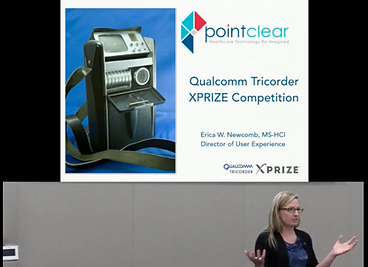
Lecture I gave at Georgia Institute of Technology


Outside the work
If you're going to hire someone to understand humans, you should probably know a little about the human you're hiring.
I captain a competitive ALTA tennis team, which has taught me more about reading people under pressure, making fast decisions with incomplete information, and keeping strong personalities aligned than any leadership training ever did. I grow things — gardens, landscapes, ideas — and find genuine satisfaction in systems that take years to mature. I bake elaborate cookies, cross stitch, watercolor, photography, and make things with my hands, because working in the abstract all day means you occasionally need to hold something real and finished and know that you made it.
I have a family I'm fiercely devoted to, a collection of dogs and cats with strong opinions about my work schedule, and a firm personal policy against anything involving heights.


What I believe about this work
Design isn't decoration. Research isn't a checkbox. And the most dangerous thing you can bring into a room full of stakeholders is a genuine understanding of the people they're supposed to be serving.
I've spent 25 years being that particular kind of dangerous.
If that sounds like what your organization needs right now — let's talk.